
The aircraft, later, flew to Guwahati after an improvement in the weather conditions in Guwahati, said KC Meena, the director of the Maharaja Bir Bikram (MBB) Airport at Agartala.

A severe cold wave has intensified across North India, with Delhi recording its lowest temperature of the season. Rajasthan experienced sub-zero temperatures, and several states have issued alerts and closed schools due to the extreme conditions.

Delhi experiences a biting chill with 'cold day' conditions and dense fog, coupled with 'very poor' air quality. The IMD forecasts continued cold weather and potential light rain.

The heatwave alert has been issued for Mumbai, Thane, Raigad and Ratnagiri on February 25 and 26, the IMD said.
Delhi is preparing for its first artificial rain through cloud seeding to combat air pollution. A trial run was successful, and the first rainfall is expected on October 29 if weather conditions are favorable.

The Andhra Pradesh government has prepared an action plan for relief and essential supplies in pre-cyclone preparedness for Cyclone Montha, expected to cross the coast on October 28.
The record monsoon rains across India during the June to September months was 937.2 millimetres, the 5th-highest since 2001 and 38th-highest since 1901.

For March 22, an Orange Alert has been issued while a Yellow Alert has been issued for Sunday.
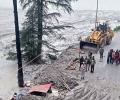
Experts question whether a cloudburst caused the recent flash flood in Uttarkashi, India, citing insufficient rainfall and other potential factors like ice chunks, rockfalls, or landslides.

Heavy rains across India have led to widespread flooding, causing damage to infrastructure, displacement of residents, and disruption of normal life. Rescue efforts are underway in affected areas.
The India Meteorological Department (IMD) reported that very dense fog began forming around 5.30 am, resulting in a thick haze over different parts of the national capital.

Heavy rains lashed Mumbai, slowing traffic and affecting train services. The IMD has issued an 'Orange' alert, advising citizens to stay indoors.

A 5.7 magnitude earthquake struck Dhaka and surrounding areas in Bangladesh, resulting in at least 10 deaths and over a hundred injuries. The quake caused building damage and fires, raising concerns about future seismic activity in the region.

Heavy rains in Nanded, Maharashtra, have caused severe flooding, leading to the evacuation of hundreds of residents as the Godavari and Asna rivers overflow. The Vishnupuri dam released a large amount of water, exacerbating the situation.

'Threat assessment, intelligence analysis, (battlefield) situation review -- what has transpired in the last three hours -- was conducted with the help of AI.'

Mumbai recorded its coldest day on Monday since December 24, 2015 with the temperature dipping to 13.7 degrees Celsius, an India Meteorological Department official said.
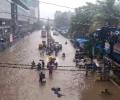
Heavy rains in Maharashtra have caused floods, road blockages, and widespread damage, resulting in casualties and displacement. The state government is monitoring the situation and coordinating rescue efforts.

Various parts of Surat were flooded after incessant rainfall in the region. Over 100 mm of rain has blocked roads and led to waterlogging in several low-lying areas.

IMD weather forecast predicted a moderate to intense spell of rain in these areas for the next three to four hours.

A landslide triggered by continuous rainfall has disrupted traffic on National Highway 75 near Kadaba taluk in Dakshina Kannada district, halting vehicular movement between Bengaluru and Mangaluru. Authorities are working to clear the debris and restore traffic flow.

Incessant rains and water-logging slowed down traffic in Mumbai, with the IMD issuing a 'red alert', predicting very heavy showers in the city and neighbouring areas. Commuters faced water accumulation on tracks and delays in local train services.

The India Meteorological Department (IMD) forecasts the withdrawal of the southwest monsoon from northwest India around September 15. This year's monsoon covered the country earlier than usual, resulting in surplus rainfall and extreme weather events.

Meanwhile, the Indian National Centre for Ocean Information Services (INCOIS) issued high sea waves, up to 4.7 metres high, warning across several coastal districts.

Heavy rains lashed Delhi, leading to a red alert, traffic snarls, and waterlogging. The IMD predicts continued rainfall.

West Bengal Chief Minister Mamata Banerjee has accused the Damodar Valley Corporation (DVC) of releasing water recklessly and without prior intimation, creating a flood-like situation in south Bengal districts during Durga Puja.
The India Meteorological Department (IMD) has forecast cloudy skies with the possibility of heavy rainfall at a few places in the city and suburbs in the next 24 hours.

North India is shivering under an intense cold wave as temperatures plummet across the region.

Heavy rains caused severe waterlogging, traffic jams, and disruptions to local train services in Mumbai. Schools and colleges were closed due to a 'red alert' issued by the IMD.

The India Meteorological Department (IMD) has predicted above-normal rainfall for most parts of India during the post-monsoon season (October to December), except for some areas in the northwest. The southwest monsoon season ended with the country recording eight per cent above normal rainfall.

A landslide in the Vikhroli suburb of Mumbai killed two people and injured two others after heavy rains caused soil and stones to collapse on a hut.

The first cloud-seeding trial has been conducted in parts of Delhi, including Burari and Karol Bagh areas, aimed at inducing artificial rain to tackle air pollution.

ne inmate was killed, and three paramilitary Frontier Corps personnel and one jail staff were injured in the Monday night incident in Karachi's Malir jail, Geo News reported.

Relentless heavy rain led to a landslide on the route to the Mata Vaishno Devi shrine atop the Trikuta hill on Tuesday afternoon, killing at least five people and injuring 14, officials said.

Severe cyclonic storm 'Montha' has begun making landfall off the Andhra Pradesh coast, with the process expected to continue for the next three to four hours. The storm is expected to cross the coast between Machilipatnam and Kalingapatnam, near Kakinada, with wind speeds of 90-100 kmph.

Seven people died after a wall collapsed near Mohan Baba Mandir in Jaitpur, Delhi, following heavy rainfall. Rescue operations were conducted by police, fire services, and NDRF teams. An investigation is underway to determine the cause of the collapse.

The forecast has an error margin of four days, which is considered normal

Mumbai recorded a minimum temperature of 16.5 degrees Celsius on Friday, the lowest for November in the last eight years, the India Meteorological Department (IMD) said. This temperature was recorded by the Santacruz observatory, which records weather parameters for Mumbai's suburbs. The Colaba observatory, which records weather parameters for the island city, registered a minimum temperature of 21.4 degrees Celsius during the same period. There is no cold wave alert for Maharashtra from November 30 to December 3, and temperature is set to rise.

India and Pakistan clash in a highly anticipated T20 World Cup match. India needs middle-order stability and a fit Abhishek Sharma, while Pakistan's spin attack poses a threat. The weather forecast predicts a high chance of rain.
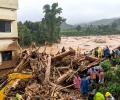
A red alert indicates heavy to extremely heavy rain of over 20 cm in 24 hours. An orange alert means very heavy rain of 11 cm to 20 cm, and a yellow alert means heavy rainfall between 6 cm and 11 cm.

Heavy rain lashed Delhi, leading to waterlogging and traffic disruptions. The IMD issued an 'orange' alert, warning of more rainfall.
